

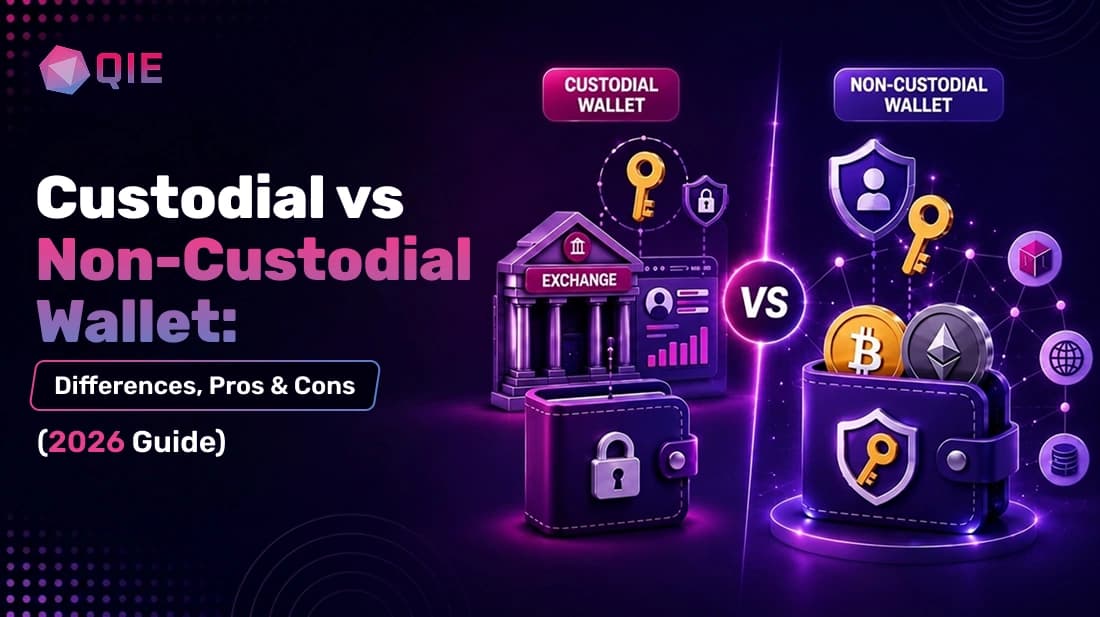
Custodial vs non-custodial wallets differ on one axis: who holds your private keys. A custodial wallet delegates that control to a third party, while a non-custodial wallet keeps it with you.
At QIE Wallet, we see this choice shape every user’s security posture and Web3 access. Pick the wrong model and you may find your funds frozen or gone permanently.
Quick Answer
Choosing between a custodial and non-custodial wallet comes down to balancing convenience and control. Custodial wallets simplify account management, while non-custodial wallets give you complete ownership of your cryptocurrency.
- •Private keys: Third party (custodial) vs. you (non-custodial)
- •Recovery: Account recovery through the provider vs. recovery phrase only
- •Security: Provider-managed protection vs. self-managed security
- •Web3 access: Limited on many custodial platforms vs. full access to DeFi, dApps, NFTs, and staking
- •Best suited for: Beginners and traders vs. long-term investors and privacy-focused users
What Is the Difference Between Custodial and Non-Custodial Wallets?
In 2025, the Bybit breach alone erased approximately $1.5 billion in ETH from wallets that were supposed to be secure. That figure should stop anyone who assumes the custody question is just a technical detail, because the model you choose determines whether a breach at someone else’s company can wipe out your balance entirely.
A custodial wallet is one where a third party, usually a centralized exchange, generates and stores your private keys on your behalf. You log in with a username and password, and the platform signs transactions for you.
With a non-custodial wallet, you alone hold the private keys, so no platform can move your funds, freeze your account, or recover your seed phrase if you lose it.
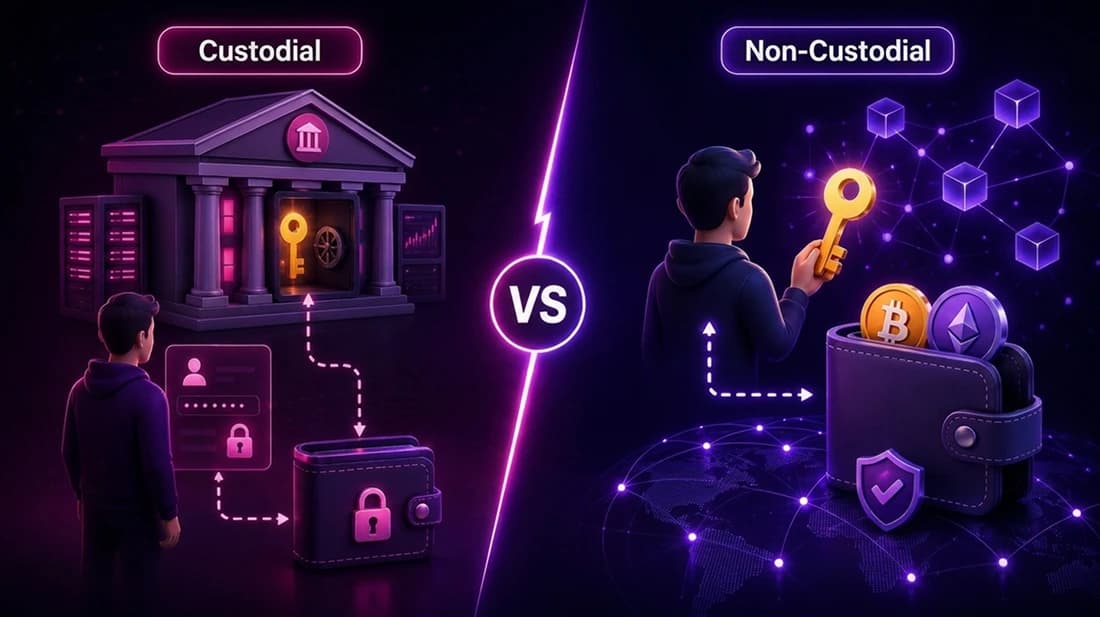
That single distinction cascades into every other difference: recovery options, regulatory exposure, DeFi access, and what happens when something goes wrong.
Quick Comparison Between Custodial and Non-Custodial Wallets
| Criteria | Custodial | Non-Custodial |
|---|---|---|
| Key control | Third party holds keys | You hold keys |
| Best for | Beginners, active traders, KYC onramps | DeFi users, long-term holders, privacy-first |
| Recovery | Support ticket + identity check | Seed phrase only, no fallback |
| Regulatory compliance | KYC/AML mandatory | Optional, user-driven |
| DeFi/dApp access | Limited to provider's platform | Full, permissionless |
| Pricing | Free accounts; trading fees apply | Free to self-host; gas fees apply |
| Key limitation | Funds can be frozen or lost if provider fails | Permanent loss if seed phrase is lost |
How Do Security, Control, and Recovery Compare?
Security is where this comparison gets concrete, and where most guides get it wrong.
Custodial Wallets
With a custodial wallet, the cryptographic control stays with the service provider. You can log in, view balances, and request transactions, but you are working through their interface rather than your own.
Reputable custodians typically protect user funds with:
- Multi-signature vaults
- Cold storage for the majority of assets
- Two-factor authentication (2FA)
- Professional security infrastructure and monitoring
That enterprise-grade security can be reassuring, especially for newcomers.
The problem is concentration. Centralized platforms accounted for 79% of all reported breaches in 2026. A single custodian pools millions of users’ assets into one target, and when that target is hit, the losses are exchange-scale.
The February 2025 Bybit breach, attributed by the FBI to the Lazarus Group, resulted in approximately $1.5 billion in ETH stolen from what were considered secure multi-signature cold wallets. That attack did not exploit a smart contract; it compromised the transaction-approval workflow at the UI layer, a reminder that even institutional-grade security can fail at the human layer.
Custodial wallets are also subject to KYC and AML regulations, meaning your assets could be frozen or seized under certain conditions. Operators are often legally obligated to follow the requests of law enforcement or government organizations.
For custodial wallets, this means:
- Identity verification is typically mandatory.
- Transactions may be monitored for regulatory compliance.
- Accounts can be temporarily frozen during investigations or disputes.
- Access may be restricted based on legal or regulatory requirements.
Under the FATF Travel Rule, virtual asset service providers must collect and transmit originator and beneficiary information for qualifying transfers. For institutional users, this compliance framework builds trust. For individual users, it also means your access can be limited even when you have done nothing wrong.
Recovery is the one area where custodial clearly wins for most people. Forget your password, contact support, verify your identity, and regain access. That process mirrors traditional finance, and it works.
Non-Custodial Wallets
Your keys live on your device or hardware, and transactions are signed locally. No platform can restrict your access, and there is no single pooled target for attackers to hit at scale.
Non-custodial wallets give you direct access to the Web3 ecosystem, including:
- DeFi protocols
- Token swaps
- dApps
- On-chain staking
- NFTs and other blockchain applications
Because you control your own keys, you do not need permission from a third-party company to interact with these services. Some self-custody wallets also support extensions and modular features that expand functionality, allowing users to connect with a wider range of blockchain protocols.
The recovery picture is unforgiving. Losing your seed phrase means permanently losing your funds. This is cryptographic reality, and phishing attacks or poor backups can trigger it just as easily as carelessness.
Most people assume non-custodial wallets are automatically safer. When we look at the data, that assumption does not hold up cleanly.
Personal wallet compromises surged in 2025, reaching 158,000 incidents and affecting at least 80,000 unique victims, though the total USD value stolen from individuals declined to $713 million compared to the prior year. Attackers are broadening their net, targeting individuals with smaller balances through phishing rather than chasing exchange vaults. Self-custody shifts the risk from counterparty failure to user error and social engineering; it does not eliminate risk.
Which Wallet Type Actually Fits Your Crypto Habits and Risk Tolerance?
Your answer depends on what you actually do with crypto, rather than what you plan to do.
Use the matrix below to find your profile quickly, then read the relevant subsection for detail.
| User Profile | Recommended Model | Primary Reason | Key Risk to Manage |
|---|---|---|---|
| Fiat onramp / first-time buyer | Custodial | Familiar login recovery, integrated fiat rails, no seed-phrase management required | Provider insolvency or account freeze; withdraw long-term holdings once comfortable |
| Active trader | Custodial (primary) | Low-latency order execution, unified trading and balance interface, exchange liquidity | Concentration risk; keep only actively traded funds on the platform |
| Long-term HODLer | Non-custodial | Full key ownership; no counterparty can freeze or seize holdings | Seed-phrase loss or theft; use hardware wallet and offline backup |
| DeFi / dApp user | Non-custodial | Direct, permissionless protocol access; custodial platforms block most DeFi interactions | Malicious contract approvals; phishing at the wallet-connection layer |
| Institutional / compliance-required | Custodial (regulated VASP) | Meets FATF Travel Rule and AML obligations; auditable custody trail for reporting | Omnibus pooling risk; verify whether the provider segregates client assets |
Custodial Wallets
Custodial wallets are typically designed for users who would rather not manage private keys directly. They also offer seamless integration between the exchange and your trading account, so buying, selling, and staking happen in one interface without manual transfers.
For someone doing KYC-required fiat onramps or frequent trading, that frictionless flow is genuinely valuable.
The trade-off is sovereignty. In a custodial model, the asset is the exchange’s liability until you withdraw it to your own wallet. That is the legal and technical reality.
Non-Custodial Wallets
For anyone building across multiple chains, staking on-chain, or holding an NFT project portfolio, self-custody is the only practical option. Custodial platforms restrict access to their own features, and most DeFi protocols simply will not connect to them.
Users who hold their own keys tend to engage with lending and borrowing protocols far more actively than custodial users, and that gap is widening as DeFi matures.
A self-custody wallet like QIE Wallet adds a layer that pure self-custody typically lacks: a reusable decentralized identity called QIE Pass, which eliminates repeated KYC checks across partner services. It supports over 1,000 coins and connects to dApps, combining identity, payments, IDs, and staking in a single product.
One genuine limitation worth naming: as a newer entrant, its partner ecosystem is still growing compared to established custodial platforms with years of exchange integrations.
Paying extra for a custodial premium service rarely makes sense if your primary need is DeFi access, because the platform’s walled garden will block most of what you want to do anyway.
What Are the Hidden Costs and Risks Most People Overlook?
Both models carry risks that do not appear in the marketing copy.
Custodial risks beyond hacks
- Regulatory freeze: A custodial setup means your assets are subject to the provider’s internal policies and external regulations. A platform can freeze or restrict your account for any number of reasons, or go dark entirely during high-volatility periods.
- Platform insolvency: The FTX collapse in 2022 erased over $10 billion in customer assets. Insurance rarely covers the full gap; the BIS reports that most products cap hot-wallet operational risk only, leaving cold-storage losses largely unprotected.
- Omnibus pooling: Some VASPs combine client assets in a single omnibus wallet rather than maintaining separate wallets per customer, and others rely on third-party custody providers rather than operating their own infrastructure. Either arrangement can introduce counterparty risk the end user never sees.
Non-custodial risks beyond seed phrase loss
- Phishing at scale: In H1 2025, 48% of exchange-platform breaches were due to phishing attacks. Non-custodial users face the same threat without a support team to call.
- Malicious contract approvals: Approving an unknown smart contract in a self-custody wallet can drain your entire balance in seconds, with no undo button and no recourse.
- Multi-wallet fragmentation: Managing separate wallets across chains without a unified identity layer means repeating KYC checks, juggling multiple seed phrases, and losing track of assets. Think of it like carrying a different passport for every country you visit, technically functional, but exhausting at scale. A one-id crypto login approach solves this directly.
Conclusion
Choosing between a custodial and non-custodial wallet comes down to balancing convenience with ownership. Custodial wallets simplify account recovery and trading but require trusting a third party with your assets.
Non-custodial wallets put you in complete control, making them the preferred choice for long-term holders, DeFi users, and anyone who values financial sovereignty.
As your crypto journey evolves, many users combine both approaches, using custodial platforms for buying or trading while keeping long-term holdings in a secure non-custodial wallet. Understanding the trade-offs allows you to build a strategy that matches your goals, experience level, and risk tolerance.
Key Takeaways
- •Whoever holds the private keys controls the crypto, and that fact alone determines your recovery options, regulatory exposure, and DeFi access.
- •Custodial platforms trade sovereignty for convenience, and that convenience has a real ceiling when exchanges face legal action, insolvency, or targeted attacks at the UI layer.
- •Self-custody moves the threat surface from a provider’s servers to your own habits, making phishing resistance and seed phrase discipline the skills that actually matter.
- •Most experienced holders split the difference: custodial for active trading, a self-custody wallet for long-term holdings and DeFi.
- •If you’re moving toward self-custody, choose a multichain wallet with a built-in identity layer rather than a single-chain tool you’ll outgrow as your on-chain activity expands.
Ready to take control of your crypto? QIE Wallet helps you securely manage over 1,000 cryptocurrencies across multiple blockchains while giving you full ownership of your private keys. Create your free wallet today and explore staking, decentralized identity, and Web3, all from one place.