

A crypto wallet is a tool that stores your private keys and lets you send, receive, and manage digital assets on the blockchain. You do not store coins inside it; you store the proof of ownership. At QIE Wallet, this distinction shapes everything about how we build our non-custodial crypto wallet, and it is the foundation every new user needs before anything else.
As more people invest in Bitcoin, Ethereum, stablecoins, NFTs, and decentralized finance (DeFi), choosing the right crypto wallet has become just as important as choosing which assets to buy.
This guide explains what a crypto wallet is, how it works, the different wallet types available, and how private keys, seed phrases, and blockchain transactions work together to keep your assets secure.
Quick Answer
A crypto wallet is a software or hardware application that stores your private keys, allowing you to send, receive, and manage cryptocurrency on the blockchain. It does not store your coins. Instead, it securely stores the credentials that prove you own and can access your digital assets.
- •Purpose: Securely manage your cryptocurrency and blockchain assets.
- •Stores: Private keys, not your crypto.
- •Types: Hot wallets, hardware wallets, custodial wallets, and self-custodial wallets.
- •Best for: Buying, storing, sending, receiving, staking, and accessing Web3 applications.
What Is a Crypto Wallet, and Why Do You Actually Need One?
A crypto wallet is software or hardware that holds the cryptographic keys proving you own your on-chain assets. Without one, you cannot access decentralised finance (DeFi), hold assets outside a bank, or control your own funds.
Global cryptocurrency owners reached 741 million in 2025, up 12.4% from 659 million in 2024, according to Crypto.com’s January 2026 Market Sizing Report. That growth means more people are learning a hard lesson: leaving funds on an exchange is a different thing from owning them.
How Do Private and Public Keys Work?
Your private key is a secret string of characters that authorises every transaction you make. Whoever holds it controls the funds. Think of it as the combination to a safe that only you know.
Your public key is derived mathematically from the private key and generates your wallet address. It lets others send assets to you, but gives no one access to what is there. You can share it freely.
The relationship runs one way. Deriving a public key from a private key is straightforward; reversing that process is computationally impossible. That mathematical trap is what makes the whole system secure.
How Do Crypto Wallets Store and Secure Your Assets?
Your coins never sit inside the wallet app itself. Cryptocurrencies live on the blockchain network, and what the wallet holds is the private key that proves you can move them. The wallet is the keyring, not the vault.
How a transaction actually flows:
You initiate a transfer in your wallet app
You enter the recipient address and the amount, and the wallet prepares the transaction for signing.
The wallet signs the transaction with your private key
The blockchain then verifies your signature using the public key and records the transaction permanently.
The funds move on-chain
Your private key never left your device at any point in the process.
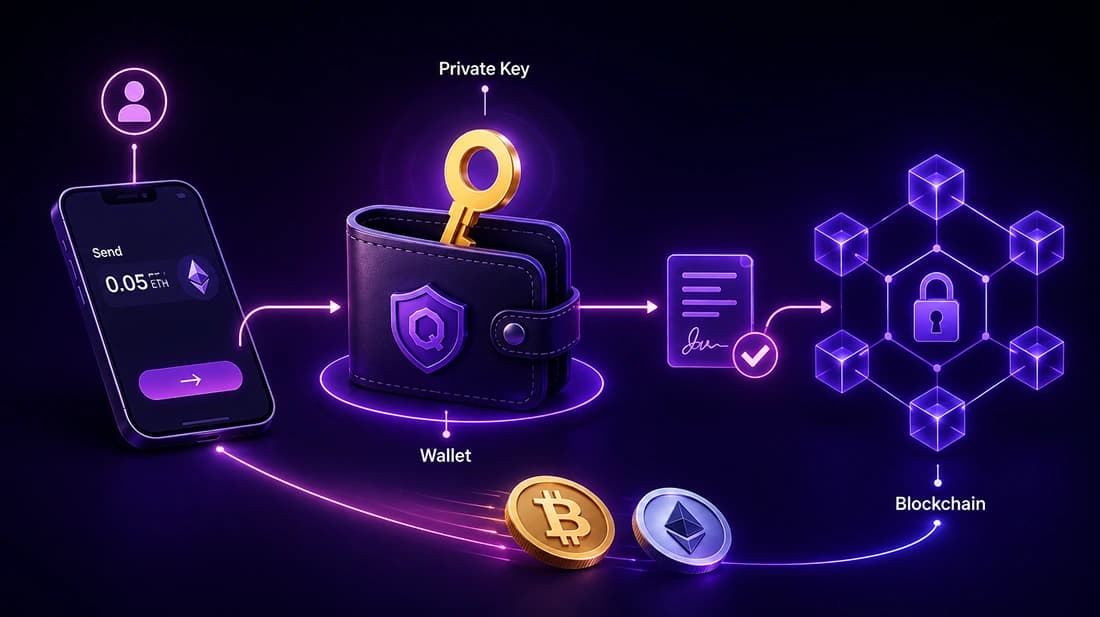
For example, sending 0.05 ETH on Ethereum mainnet in mid-2026 costs roughly $0.50–$2.00 in gas, paid from the same wallet address. The wallet calculates the fee, bundles it into the signed transaction, and the entire process takes under 30 seconds once confirmed.
That signing step is the mechanism most guides skip over. Your key proves authorisation without ever being broadcast to the network, which is why sharing your public address is safe and sharing your private key is catastrophic.
Custodial vs. Self-Custodial Wallets
When you buy cryptocurrency on a centralised exchange, the platform keeps custody of the private keys and therefore control of your assets. You have no choice but to trust it with your funds. A self-custodial wallet flips that arrangement: you hold the keys, you have true ownership, and no platform decision can freeze or lose your balance.
This is the architecture behind every proper self-custody wallet, including the multichain wallet category. “Not your keys, not your coins” is a description of how the protocol actually works.
Why Are Hardware Wallets More Secure?
Hardware wallets keep private keys on a physical device that never connects to the internet during signing, which is why they offer the strongest protection against hacking and exchange failures. These devices typically cost $50 to $200.
Ledger’s track record illustrates the value: the company confirmed over 8 million devices sold and zero hacks across a decade of operation, as of March 2026. The trade-off is friction. Every transaction requires physical confirmation on the device, which slows down active trading considerably.
What Are the Common Types of Wallets, and Which One Fits Your Needs?
The right wallet depends on how you use crypto, not on which one has the most features.
| Wallet Type | Where Keys Live | Best For | Main Trade-off | Recovery Path |
|---|---|---|---|---|
| Hot wallet (mobile/browser) | On your internet-connected device | Daily trading, DeFi, swapping | Convenient but exposed to online threats | Seed phrase import into any compatible app |
| Hardware wallet | Offline physical device | Long-term holding, large balances | Maximum security, slower to transact | Seed phrase + device PIN reset |
| Non-custodial wallet | On your device | Self-custody, DeFi, Web3, long-term ownership | You are responsible for your recovery phrase | Seed phrase import into any compatible wallet |
| Custodial (exchange) | Provider holds keys | Beginners, fiat on-ramps | Easy setup, no true ownership | Platform account recovery (email/2FA) |
| Multichain wallet | On your device, across chains | Cross-chain DeFi, NFT project access | Requires seed phrase discipline | Seed phrase import, all chains restored |
Hot wallets hold 78% market share, which makes sense given that most users prioritise daily convenience.
Convenience and security pull against each other, though, and the wallet you choose for a small NFT project budget should differ from the one holding your long-term savings.
How Can You Use One Verified Identity Across Multiple Wallets and Services?
The single most overlooked friction in Web3 is re-verification: every new exchange, every new dApp, another KYC form. Understanding what your seed phrase actually is helps clarify why a better model is possible.
What Is a Seed Phrase and Why Is It Important?
A seed phrase, or secret recovery phrase, is a list of 12, 18, or 24 human-readable words that can regenerate all your private keys. The 12-to-24-word format is standardised under BIP-39, the Bitcoin Improvement Proposal that most wallets follow, which means a phrase generated in one compliant wallet can be imported into any other.
It represents the private key in a format you can write down and carry. Lose the phrase and the funds are gone permanently, with no reset available.
The seed phrase is also what lets you move your identity between devices. Import it into a new phone and your entire wallet history reappears in seconds.
In our support queue, the most common recovery failure we see is a phrase stored in the correct order but with one word misspelled because the user typed it rather than writing it by hand. Autocorrect silently changes “stereo” to “stereos,” or “arena” to “area,” and the resulting phrase fails to import with no obvious error message explaining why.
A second pattern we see regularly is users who split their phrase across two locations for safety and then lose one half. BIP-39 requires all words in sequence; a partial phrase recovers nothing. Write the full phrase by hand, in one sitting, on paper or a dedicated metal backup, and store it as a single complete document.
Human-Readable IDs: Replacing the Address String
Long wallet addresses are easy to mistype. A single incorrect character can send funds to the wrong destination, which is why human-readable crypto IDs are becoming an important part of the Web3 experience.
Instead of copying and pasting long strings of letters and numbers, you can use a simple wallet name like yourname.qie to send and receive digital assets more confidently.
Beyond simplifying payments, .qie IDs also help establish a reusable on-chain identity. Rather than remembering multiple wallet addresses across different blockchains and applications, you can use one recognizable identity throughout the Web3 ecosystem.
Other blockchain naming services, such as Ethereum Name Service (ENS) with .eth domains and Unstoppable Domains with extensions like .crypto and .nft, have demonstrated the growing demand for human-readable wallet identities.
As Web3 continues to evolve, ID-based identities are becoming an important step toward making cryptocurrency transactions simpler, safer, and more user-friendly.
These names do more than simplify payments. In decentralised lending systems, your crypto ID can represent your on-chain identity, reducing friction compared to centralised platforms that require fresh KYC logins each time.
One-Click Verification: the Emerging Standard
The most practical evolution here is a reusable decentralised identity: verify once, then carry that credential across partner platforms. A user verifies through a Web3 wallet app that supports a portable credential layer.
That credential, tied to their wallet ID, is recognised by partner exchanges and dApps, so the next connection is a one-click confirmation rather than a fresh form.
Options like QIE Wallet’s QIE Pass approach solve this problem differently. When we built QIE Wallet as a non-custodial, multichain cryptocurrency wallet paired with QIE Pass, the goal was exactly this: support over 1,000 coins and connect to dApps so users can swap crypto across networks without re-entering KYC at each stop.
For a practical walkthrough of cross-chain swapping, the guide to swapping crypto on QIE Wallet shows the exact steps from wallet connection to confirmed transaction.
Conclusion
A crypto wallet is more than a place to manage digital assets. It is the tool that gives you ownership of your cryptocurrency. Whether you choose a hardware wallet for maximum security or a self-custodial mobile wallet for everyday Web3 use, understanding how private keys, seed phrases, and wallet types work is essential to protecting your funds.
The better you understand your wallet, the more confidently you can participate in the growing blockchain ecosystem.
Key Takeaways
- •Your private keys live in the wallet; your coins live on the blockchain. The key is your only proof of ownership, which means protecting it is the whole job.
- •Custodial wallets hand control to a platform in exchange for convenience. Self-custody gives you genuine ownership, and the right choice depends on your balance size and how actively you trade.
- •Keeping private keys permanently offline, as hardware wallets do, is the strongest option for long-term holdings, even though it slows down individual transactions.
- •A single 12-to-24-word seed phrase can restore your full wallet on any compatible device, which also means losing it means losing everything with no recourse.
- •Anyone managing assets across multiple chains or partner services should look for a wallet with a reusable identity layer, so KYC happens once and travels with you.
Ready to take full control of your crypto? QIE Wallet lets you securely manage more than 1,000 cryptocurrencies across multiple blockchains while giving you complete ownership of your private keys. Create your free wallet today and explore staking, decentralized identity, and Web3 from one secure app.