

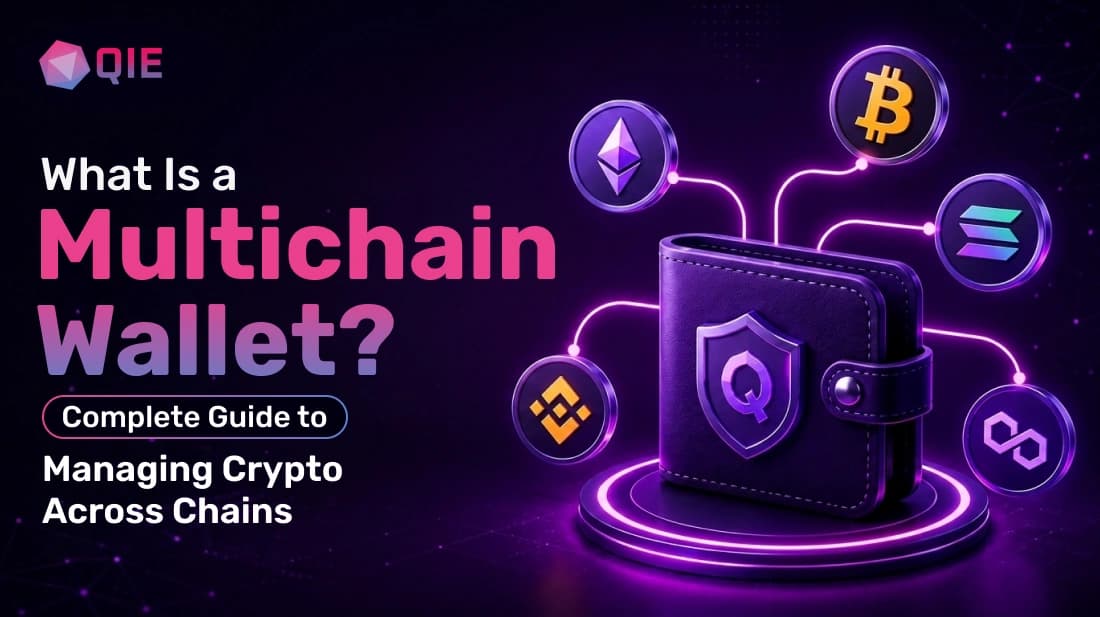
A multichain wallet is a single self-custody wallet app that stores, sends, and manages assets across multiple blockchains simultaneously without requiring a separate wallet per chain. At QIE Wallet, we see users hold ETH on Ethereum, SOL on Solana, and MATIC on Polygon all from one dashboard, eliminating the fragmented experience that drives most Web3 newcomers away.
As the blockchain ecosystem grows, managing multiple wallets becomes increasingly complex. A multichain wallet solves this by bringing your assets together while keeping you in control of your private keys.
This guide explains what a multichain wallet is, how it works, its benefits, and how to choose the right one for your needs.
Quick Answer
A multichain wallet is a self-custody crypto wallet that lets you manage assets across multiple blockchain networks from one application. Instead of creating separate wallets for Ethereum, Solana, Polygon, and other chains, you use one wallet, one recovery phrase, and one interface to store, send, swap, and manage your cryptocurrency.
- •Supports: Multiple blockchain networks
- •One seed phrase: Secures all supported chains
- •Best for: DeFi, NFTs, cross-chain investing, and Web3
- •Main benefit: Manage all your crypto from one wallet
What Is a Multichain Wallet and Why Does It Matter?
A multichain wallet, in plain terms, is a single interface that manages digital assets across multiple independent blockchain networks without requiring separate installations or seed phrases per chain.
You store, send, receive, and manage everything from one self-custodial application instead of juggling five different apps. For example, you can view your BTC, ETH, SOL, and USDC balances together while maintaining full control of your private keys.
The pain point it solves is real. As of early 2026, industry estimates suggest there are now over 1,000 active public blockchains, each with its own address format, token standard, and wallet requirement.
Without a multichain wallet, a DeFi trader active on three chains needs three seed phrases, three interfaces, and often three separate Know Your Customer (KYC) verifications. A well-built multichain wallet collapses all of that into one step.
How Do Multichain Wallets Actually Work Under the Hood?
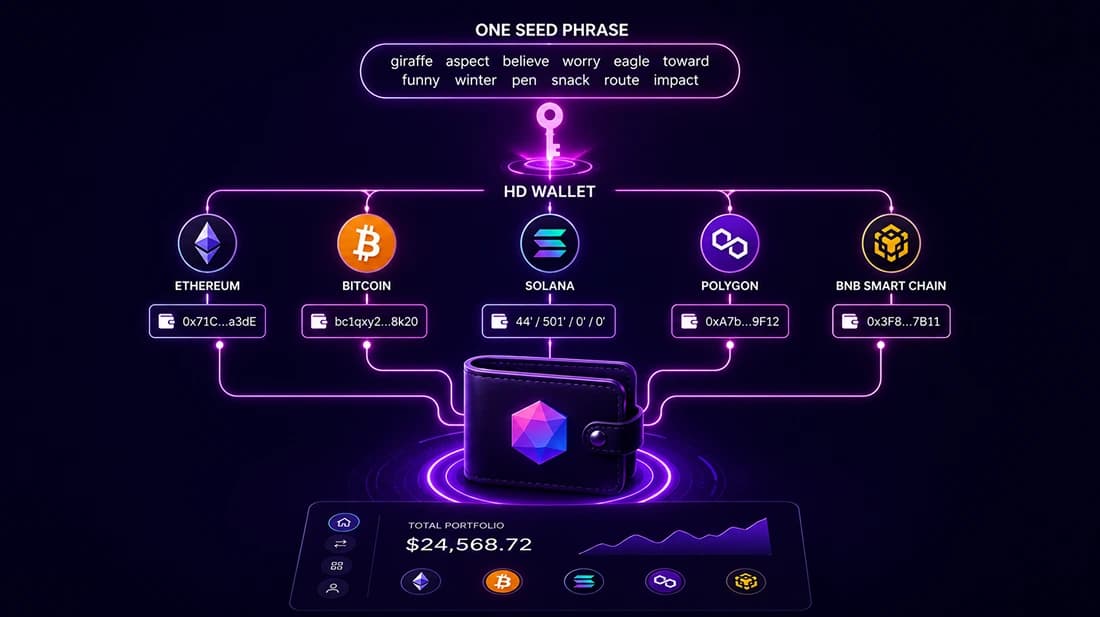
At a high level, a multichain wallet uses one recovery phrase to generate separate wallet addresses for every supported blockchain while presenting them in a single interface.
The foundation is a hierarchical deterministic (HD) wallet paired with chain-specific derivation paths. An HD wallet uses a single seed phrase to generate every address you will ever need across every coin, through a deterministic tree of derived keys.
Think of the seed phrase as a master key cut once, where every chain-specific address is a copy of that key shaped for a different lock.
Derivation Paths and Multiple Network Standards
One seed phrase can secure many chains because wallets use HD standards (BIP-39/BIP-32/BIP-44) to derive chain-specific keys. BIP-44 assigns a unique number to each coin, directing the wallet to the correct set of keys. Ethereum’s coin-type is 60’, Bitcoin’s is 0’, and so on.
The wallet software handles this routing invisibly; you just see one unified portfolio view.
Token support is not automatic. Wallets index assets using standards like ERC-20, BEP-20, SPL, and TRC-20, plus verified token lists. This is why a freshly added chain sometimes shows a zero balance until the wallet’s indexer catches up.
Cross-Chain Swaps and Bridge Mechanics
Managing assets natively on each chain is straightforward. Moving value between chains is where things get more involved. Cross-chain transfers require bridge protocols, specialized infrastructure that transfers value between different blockchain networks using mechanisms such as liquidity pools, messaging protocols, or asset wrapping.
For example, if you want to move ETH from Ethereum to Solana, your multichain wallet routes the transaction through a supported bridge protocol. The wallet handles the technical process behind the scenes, so you only see a simple transfer or swap interface.
Some wallets integrate bridges such as Stargate, which is built on LayerZero and enables cross-chain transfers between supported blockchain networks. Instead of requiring users to manually connect to separate bridge applications, the wallet manages the process within a single interface, making cross-chain transfers faster and more convenient.
The end result is a seamless experience: you initiate a transfer with a few clicks, while the wallet automatically handles the underlying bridge mechanics, network routing, and transaction execution in the background.
You can explore this in practice in QIE Wallet’s guide to crypto swap and adding network features, which walks through the exact steps for cross-chain swaps inside the wallet.
One thing most guides skip: supporting many chains and bridging assets between them are two separate capabilities with different risk profiles. A wallet can hold ETH and SOL natively without ever bridging them. Bridging only enters the picture when you want to move value from one chain to the other.
What Are the Real Trade-Offs Between Multichain Wallets and Single-Chain Alternatives?
Single-chain wallets excel at depth, while multichain wallets excel at breadth. Neither approach is universally better.
| Feature | Multichain wallet | Single-chain wallet |
|---|---|---|
| Asset coverage | 1,000+ coins across many chains | Deep support for niche tokens on one chain |
| Seed phrase risk | One phrase, one point of failure | One phrase per wallet, isolated exposure |
| Identity & KYC | Reusable across partner services (e.g. QIE Pass) | Siloed per platform |
| Mobile UX | Varies by wallet; improving rapidly | Often superior mobile UX for native chain |
| dApp browser | Broad, multi-ecosystem | Optimised for one ecosystem |
| CEX integration | Varies | Coinbase Wallet: seamless integration between the centralized exchange and self-custody |
| Best for | DeFi traders active on 3+ chains | Power users maximising one ecosystem |
How Popular Multichain Wallets Compare
Some wallets are designed primarily for Ethereum and EVM-compatible networks, with optional extensions that add support for additional blockchains. While this approach offers flexibility, it often requires extra setup and may be less convenient than wallets with native multichain support.
The wallet that actually serves you depends entirely on where you spend most of your on-chain time.
| Wallet | Best for | Non-EVM support | Identity portability | Mobile UX rating |
|---|---|---|---|---|
| MetaMask Snaps | EVM power users extending into non-EVM chains | Via third-party Snaps (experimental) | None native | Moderate |
| Trust Wallet | Mobile-first retail users with broad altcoin needs | Yes (native multi-standard support) | None native | Strong |
| Coinbase Wallet | Users already in the Coinbase ecosystem | Limited | Siloed to Coinbase partners | Strong |
| QIE Wallet | Users who need identity portability across dApps alongside multi-chain access | Yes (1,000+ coins) | QIE Pass reusable verified identity | Strong |
How Do You Choose and Set Up a Multichain Wallet for Your Needs?
Start with your use case, not the feature list. A DeFi trader needs deep chain support and fast bridging. A retail spender needs merchant integrations and a clean mobile interface.
An NFT collector needs multi-chain marketplace access and a clear NFT display. Matching wallet to use case first prevents the most common mistake: picking the most-featured wallet and then struggling with its complexity.
Decision Framework
Evaluate candidates on four dimensions:
- Supported chains: Does it cover every chain you actively use, including any Layer 2 you are staking on?
- Built-in features: Staking, wallet IDs, and merchant integrations reduce the number of external tools you need.
- Identity portability: Does the wallet offer a reusable decentralized identity, or will you repeat KYC on every new platform?
- Regulatory trust signals: For users in regulated jurisdictions, a wallet built with compliance-ready infrastructure matters.
Setup Checklist
Back up your seed phrase offline before funding anything
Write it on paper, store it somewhere physically secure, and never photograph it. This is the step people skip, and it is the only one that is truly irreversible.
Run a small test transfer first
Before moving significant assets, send $5 worth of a token from Ethereum to Polygon, confirm it arrives, and verify the address format is correct on both ends. Catching a misconfiguration on a $5 test costs nothing; catching it on a $5,000 transfer costs everything.
Enable hardware wallet pairing
If your holdings exceed what you would be comfortable losing to a phishing attack, pair a hardware device. Most multichain wallets support Ledger or Trezor.
Confirm your destination-chain address is visible in your wallet before initiating any bridge transaction. This catches address-format errors before funds are in flight.
For a step-by-step walkthrough of swapping across chains, QIE Wallet’s guide to swapping crypto covers the exact process with screenshots.
When we look at what separates wallets for users who need more than asset storage, the answer is usually identity. QIE Wallet is a non-custodial wallet supporting over 1,000 coins and connecting to dApps, and its QIE Pass feature is a reusable verified identity that eliminates repeated KYC across partner services, a capability none of the three major competitors above currently offer natively.
Conclusion
Managing crypto across multiple blockchains does not have to mean juggling multiple wallets, recovery phrases, and interfaces. A multichain wallet brings your assets together in one place while preserving the security and ownership that come with self-custody.
Whether you are trading across networks, staking tokens, collecting NFTs, or exploring DeFi, the right multichain wallet helps simplify your experience without sacrificing control.
As the blockchain ecosystem continues to expand, choosing a wallet that supports multiple networks, secure cross-chain transactions, and a seamless Web3 experience will save time and reduce complexity. The best multichain wallets do not just store your assets. They make it easier to participate confidently across the entire crypto ecosystem.
Key Takeaways
- •A multichain wallet lets you manage cryptocurrencies across multiple blockchain networks from a single interface, eliminating the need to switch between separate wallets.
- •A single seed phrase, generated using HD wallet standards, securely restores your addresses and assets across all supported blockchains.
- •Holding assets on multiple chains and transferring them between chains are different functions. Cross-chain transfers require bridge protocols and involve additional considerations.
- •Good security practices matter just as much as the wallet you choose. Always back up your recovery phrase offline, test large transfers with a small transaction first, and consider using a hardware wallet for significant holdings.
- •When choosing a multichain wallet, look beyond the number of supported blockchains. Features like native cross-chain swaps, staking, dApp connectivity, and reusable identity can significantly improve your Web3 experience.
Ready to simplify how you manage crypto? QIE Wallet lets you store, send, swap, and manage your assets across multiple blockchains from one self-custodial wallet. Create your free wallet today and explore Web3 with confidence.