

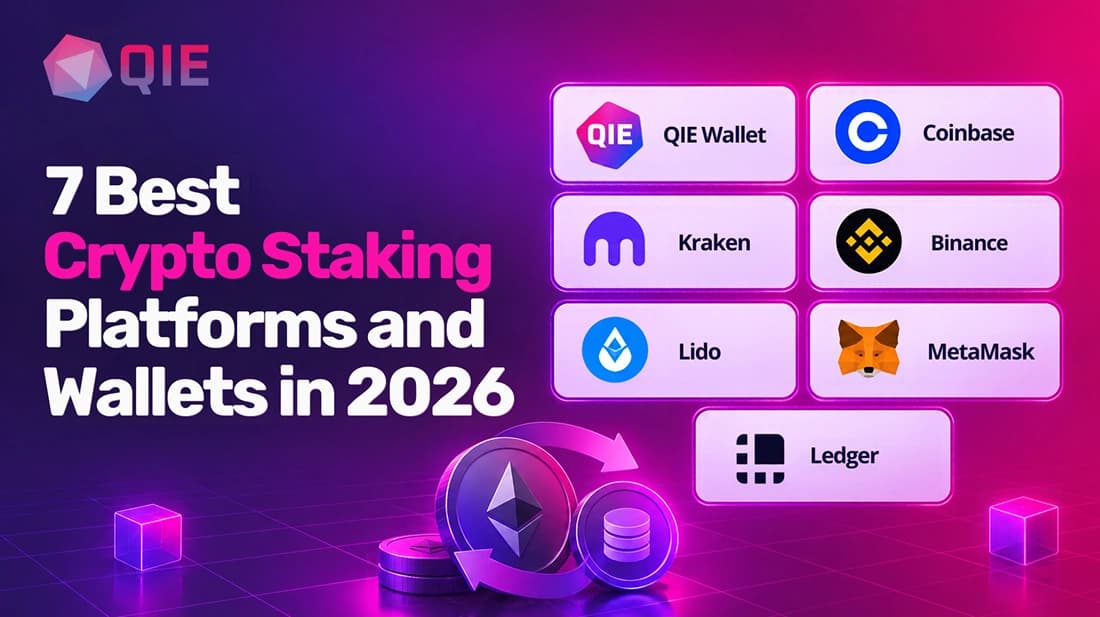
The best crypto staking platform is not the one with the highest APY. Rewards, lock-up, fees, custody and risk all matter.
This guide compares seven staking platforms and wallets, QIE Wallet, Coinbase, Kraken, Binance, Lido, MetaMask and Ledger, so you can pick the way to stake that fits how you hold and how much risk you accept.
Quick Answer
The best crypto staking platform depends on what you value most. If you want self-custody with staking built into one app, QIE Wallet is a strong pick. Exchanges are simple but hold your keys, and liquid staking keeps your coins movable. Here is who each option suits:
- •QIE Wallet: non-custodial staking inside the app, with up to 15% APY and no extra staking fee beyond network fees.
- •Coinbase and Kraken: familiar exchanges that hold your keys and take a commission on rewards.
- •Binance: ETH staking from 0.0001 ETH, with WBETH as the receipt token.
- •Lido: liquid ETH staking with a 10% fee on rewards.
- •MetaMask: pooled ETH staking from a self-custody wallet.
- •Ledger: hardware-wallet staking, with minimums and lock-ups that depend on the blockchain.
Best crypto staking platform: how to choose
Weigh five things together: rewards, lock-up, fees, custody and risk. A high headline rate means little if your coins are trapped for weeks or the platform keeps a large share of rewards.
| If you want | Pick | Trade-off |
|---|---|---|
| Self-custody with staking built into the app | QIE Wallet | The rate applies to QIE specifically |
| A familiar app for a first stake | Coinbase or Kraken | The exchange holds your keys and takes a commission |
| ETH you can still move while it earns | Lido | You hold stETH and pay a share of rewards |
| ETH staking from a wallet you control | MetaMask | A fee on rewards, and ETH only |
| Hardware security | Ledger | Rewards and lock-ups vary between blockchains |
Rewards, and why APY alone misleads
APY, or Annual Percentage Yield, is the yearly return including compounding. Rates are estimates that move with network conditions, and what you keep is what is left after fees.
Lock-up and unstaking
Ask how long unstaking takes before you stake. On some networks and platforms you can leave in minutes, while others make you wait days or weeks.
Fees and minimums
Fees hide in the commission. A platform that takes a share of rewards leaves you with less than the network pays.
Lido takes 10% of rewards, MetaMask took a 15% rewards fee when it launched pooled staking in June 2024, and Coinbase and Binance both charge a commission on rewards, as their own pages state. Identical network rewards can leave you with different amounts.
Custody and platform risk
A non-custodial wallet means you hold the private keys, while a custodial platform holds them for you.
How we evaluated these platforms
We compared each platform on five points: custody, fees, lock-up, flexibility and ease of use. Every fact comes from the platform’s own staking, fee or help page, and the details in this guide were checked in October 2026.
This guide does not show a live APY table on purpose. Rates change daily and differ by country, so a snapshot would be out of date within days, and some pages, such as Binance’s ETH staking page, show no fixed rate at all. The live rate on each platform’s own page is the number to trust.
The 7 best crypto staking platforms and wallets, compared
Details below come from each platform’s own staking or fee page. Rates and fees change, so confirm the current terms before you stake.
| Platform | Custody | Minimum and lock-up | Fee on rewards | Best for |
|---|---|---|---|---|
| QIE Wallet | Non-custodial | You choose a staking duration in the app | No staking fee beyond network fees | Self-custody staking with ecosystem perks |
| Coinbase | Custodial | Unstaking can take from hours to weeks, depending on the asset | Commission on rewards; rate depends on account type | A familiar app for a first stake |
| Kraken | Custodial | Bonding and unbonding periods vary by asset | Varies by asset and region | Exchange users who want many assets |
| Binance | Custodial | From 0.0001 ETH | A commission is charged; the rate is not shown on the page | ETH staking with a tradable token (WBETH) |
| Lido | Non-custodial protocol | Receive stETH, a transferable token | 10% of rewards | Liquid ETH staking |
| MetaMask | Non-custodial wallet | Any ETH amount; unstake in a couple of days | 15% of rewards at launch (June 2024) | ETH holders who already use MetaMask |
| Ledger | Self-custody hardware wallet | Varies by blockchain | Varies by blockchain | Long-term holders who want hardware security |
Data checked: October 2026.
Platform scorecard
This is our assessment, based on the facts in the table above, and not a measured score. High is better in every column.
| Platform | Custody control | Fee clarity | Flexibility | Ease of use |
|---|---|---|---|---|
| QIE Wallet | High | High | Medium | High |
| Coinbase | Low | Medium | Medium | High |
| Kraken | Low | Medium | Medium | Medium |
| Binance | Low | Low | High | Medium |
| Lido | High | High | High | Medium |
| MetaMask | High | Medium | Medium | Medium |
| Ledger | High | Low | Low | Low |
1. QIE Wallet
QIE Wallet is a non-custodial, multichain wallet with staking built in, so your staked assets stay under your private key and rewards go to you. You pick the amount and the duration in the app, and there is no extra staking fee beyond the network transaction fee. QIE Wallet staking gives up to 15% APY, which is a maximum.
QIE stakers also unlock perks: up to 50% off QIE IDs and free partner subscriptions such as Galaxi and Qbots. The wallet supports 1,000+ coins across multiple chains, and you get a free QIE ID that doubles as one reusable, verified identity across partner platforms.
The rate applies to QIE specifically, so it suits you if you want exposure to the QIE ecosystem. For a walkthrough, see the QIE Wallet staking guide.
Watch out for: the up to 15% APY is variable, and staking QIE means holding QIE price risk.
2. Coinbase
Coinbase is a custodial exchange, so it holds your keys and stakes on your behalf. Staking itself carries no fee, but Coinbase takes a commission on rewards, and the rate depends on the asset and on your account type.
Unstaking can be quick or slow depending on the asset, and instant unstaking can cost extra.
Watch out for: the commission. Read Coinbase’s current fee page and compare your net reward, not the headline rate.
3. Kraken
Kraken is another custodial exchange with staking across many assets. Its staking rates and terms differ by asset and by country, so the same coin can show a different rate on a different regional page. Bonding and unbonding periods also vary by asset.
Watch out for: regional availability and rates. Check the Kraken staking page for your country before you decide.
4. Binance
Binance offers ETH staking from as little as 0.0001 ETH, and you receive WBETH, a token that represents your staked ETH and its rewards.
You can use WBETH in DeFi while it keeps earning. Staking ETH directly on the Ethereum network needs 32 ETH and your own node, which is why pooled options exist.
Watch out for: Binance says a commission is charged on rewards and that the APR is variable and not guaranteed.
5. Lido
Lido is the liquid staking option. You swap ETH for stETH, a token that represents your stake and earns rewards while staying transferable. Lido takes 10% of rewards, shared between node operators and the DAO treasury.
Watch out for: the rate is an estimate and can change at any time, and stETH adds smart contract risk on top of staking risk.
6. MetaMask
MetaMask Pooled Staking lets you stake any amount of ETH from inside MetaMask and unstake in two steps.
It runs on Consensys Staking infrastructure, which the announcement says has had zero slashing incidents since 2020. That is the company’s own claim, so treat it as directional.
Watch out for: the fee. The announcement, published in June 2024, says MetaMask takes a 15% rewards fee, so check its current terms.
7. Ledger
Ledger is a hardware-wallet option. You stake through Ledger by delegating to a validator, which shares the rewards it collects. The minimum and the lock-up depend on the blockchain you stake on.
Watch out for: every blockchain works differently, so check the asset you want before you commit.
Custodial, non-custodial and liquid staking: what is the difference?
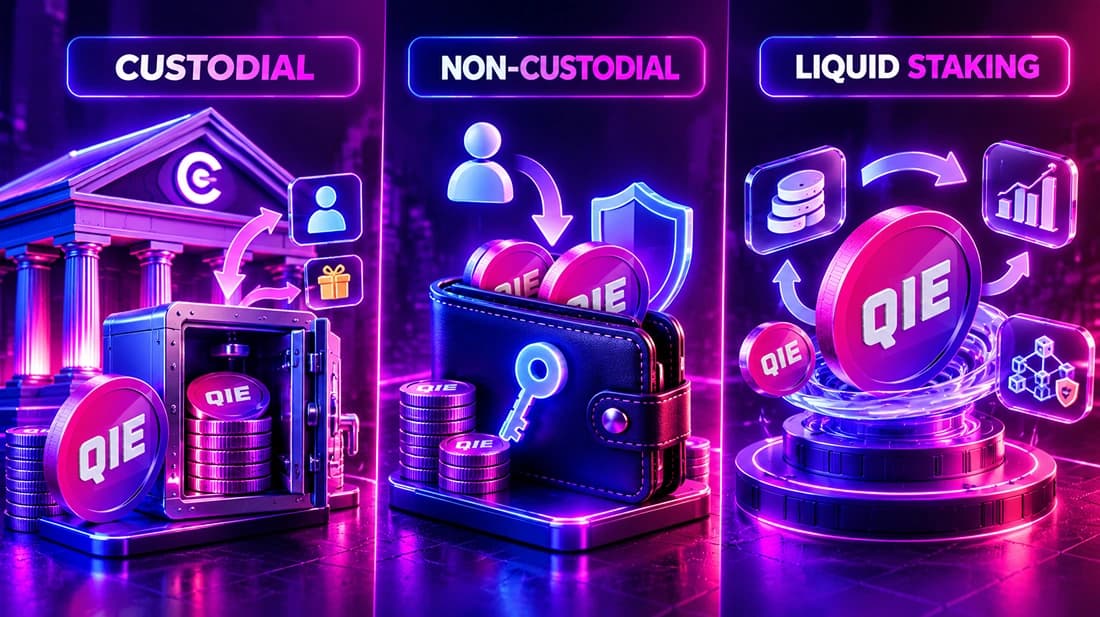
The three main ways to stake differ in who holds your keys and what you get back.
| Type | Who holds your keys | What you get | Main trade-off |
|---|---|---|---|
| Custodial (exchange) | The platform | Rewards credited to your account | Simple, but you rely on the platform |
| Non-custodial (wallet) | You | Rewards paid to your wallet | Full control and full responsibility |
| Liquid staking | You or a protocol | A token that represents your stake | Flexible, but adds smart contract risk |
Exchange staking is the easiest start. Wallet staking gives you control, and nobody can reset a lost recovery phrase for you. Liquid staking lets you keep using your value in DeFi while it earns, at the cost of an extra layer of risk.
Which staking option fits your goal?
Match the option to what you want from your coins:
- First-time staker who wants simplicity: a familiar exchange app, or QIE Wallet if you want to learn self-custody at the same time.
- Long-term holder who wants control: a self-custody wallet such as QIE Wallet or Ledger, so no platform can freeze your coins.
- ETH holder who wants flexibility: liquid staking with Lido, or pooled staking in MetaMask.
- DeFi user: a liquid staking token such as stETH or WBETH, with the added smart contract risk in mind.
- Technical user with serious holdings: running your own validator. See our guide on how to become a validator.
High APY crypto staking: what to know before you chase the highest APY
High APY crypto staking is tempting, but a high number is often a warning and not a bargain. Rates differ by asset, by platform and by country, and a high rate can reflect a long lock-up, a volatile coin or heavy token inflation.
Always compare what you keep after fees. Net reward is roughly the gross reward times one minus the fee. For example, a hypothetical 6% gross rate with a 10% fee leaves about 5.4% (6% x 0.9). The same 6% with a 35% commission leaves about 3.9%. These numbers are illustrations only.
Best staking wallet
The best staking wallet gives you the private keys, shows fees before you confirm, and supports your coin. Self-custody gives you control and full responsibility, so back up your recovery phrase offline. QIE Wallet, MetaMask and Ledger are self-custody options for different coins.
Staking risks: slashing, lock-up, price risk and platform failure
Staking carries four real risks, and none of them depends on which logo you pick.
- Slashing: validators that act dishonestly or miss network requirements can lose part of their staked assets.
- Lock-up: unstaking can take from minutes to weeks depending on the asset, and the network must finish unstaking before you can transfer or sell.
- Price risk: a high rate means little if the token falls in value. Rewards are paid in the asset you stake.
- Platform risk: the platform you stake through can change terms or run into trouble, so weigh who holds your keys.
Digital-asset investing can result in loss of capital. This article is informational, not financial or tax advice, and rules differ by country.
How to stake in QIE Wallet
Staking in QIE Wallet takes six steps:
Download and set up QIE Wallet
Get it only from the official store or site.
Buy or deposit QIE
Send QIE in, or buy it in the app.
Open the Staking section
It sits in the app menu.
Choose the amount and the duration
Check the rate shown, which is variable.
Confirm and stake
Approve with your key.
Track your rewards
Watch them in the app.
New to staking? Start with our explainer, what is crypto staking and how does it work. If you want to run the network yourself, see how to become a validator.
Conclusion
There is no single best crypto staking platform. Pick the one that matches your coin, your comfort with custody and the lock-up you can live with.
QIE Wallet suits people who want self-custody staking in one app, and exchanges and liquid staking suit people who value simplicity or flexibility.
Key takeaways
- •Judge any staking platform on rewards, lock-up, fees, custody and risk together, never on headline APY.
- •The cut taken from rewards matters as much as the rate, so compare commissions before you compare rates.
- •Self-custody wallets give you control and full responsibility.
- •Every rate moves, so confirm the live figure on the platform's own page before staking.
- •If you want self-custody staking with perks bundled in, start with QIE Wallet.
Ready to earn? Stake in QIE Wallet and keep control of your keys.