

What is crypto staking? It is a way to earn rewards by locking coins on a proof-of-stake blockchain. It sounds simple, but the details matter: who holds your coins, how long they stay locked, and what can go wrong.
This guide explains how crypto staking works step by step, the ways to stake, how rewards are calculated and the risks.
Quick Answer
Crypto staking is a way to earn rewards by putting your coins to work on a blockchain. You lock them, the network uses that stake to stay honest, and you receive more of the coin in return. In short:
- •Staking: locks your crypto to help secure a blockchain, and the network pays you rewards.
- •Proof of stake: is the rulebook a network uses to agree on valid transactions. It relies on economic stake instead of computing power.
- •Validator: a network participant who checks transactions and adds new blocks.
- •Delegation: means you hand your stake to a validator and share the rewards, without running any software yourself.
- •Rewards are not guaranteed, and your coins are usually locked while staked.
What is crypto staking in simple terms?
Crypto staking is like putting your coins to work for the network. You commit them for a while, and in return the network pays you for helping keep it secure and honest.
It only works on proof-of-stake blockchains, which is why you cannot stake Bitcoin the way you can stake coins like QIE, ETH, or SOL.
How does crypto staking work step by step?
Staking follows one loop: lock coins, get a validator chosen, earn for honest work, lose stake for cheating, and collect rewards. Here it is in order.
| 1. Lock coins | 2. Validator chosen | 3. Blocks validated | 4. Rewards paid | 5. Cheaters slashed |
|---|---|---|---|---|
| You commit your coins to the network | The network picks validators by stake | Validators check transactions and add blocks | Honest work earns new coins | Dishonest work loses part of the stake |
- You lock your coins. You commit an amount to a staking program, often called bonding. Some networks require a minimum and most have a bonding period before rewards start.
- The network picks validators. Proof of stake weighs economic stake rather than computing power, so more locked stake means more influence.
- Validators do the checking. They confirm transactions and add blocks. On Ethereum, according to ethereum.org, time is split into 12-second slots, and one validator is randomly chosen to propose a block in each.
- Cheaters are punished. This is called slashing: the protocol destroys part of a dishonest validator’s stake.
- You collect rewards. Honest participation is paid in the staked coin.
Where delegation fits
Running a validator is demanding. Per ethereum.org, an Ethereum validator must deposit 32 ETH and run three separate pieces of software. Delegation skips all that. You point your stake at an existing validator, who does the technical work, and you share the rewards after the validator’s commission.
Picture a shared allotment. You supply the seed money, someone else does the daily digging, and the harvest is split.
Where do staking rewards come from?
Staking rewards come from the network itself. On most proof-of-stake chains, validators earn newly issued coins for each block they help produce, plus a share of the transaction fees users pay. Delegators receive their part of those earnings after the validator takes its commission.
This matters for one reason: a higher reward can come from higher inflation, which dilutes everyone who does not stake. So a high rate is not free money. It is a share of new supply that the network pays out to secure itself.
Staking terms in plain words
| Term | What it means |
|---|---|
| Staking | Locking coins to help secure a proof-of-stake blockchain and earn rewards |
| Proof of stake | A way for a network to agree on valid transactions using locked coins instead of computing power |
| Validator | A node operator who checks transactions and adds new blocks |
| Delegator | A coin holder who stakes behind a validator without running a node |
| Slashing | A penalty that destroys part of a validator's stake for breaking the rules |
| Unbonding | The waiting period after you unstake before your coins can move again |
| APR | The yearly reward rate with no compounding |
| APY | The yearly reward rate including compounding |
| Liquid staking token | A token you receive for staking that represents your stake and can be traded |
What are the different ways to stake crypto?
There are several ways to stake, and they differ mostly in who holds your coins and how much technical skill you need.
| Method | How it works | Skill needed | Best for |
|---|---|---|---|
| Run a validator | You operate the node yourself and carry full responsibility | High | Technical users with serious holdings |
| Delegate to a validator | You assign your stake to a validator who does the work | Low | Beginners who want to earn without running software |
| Centralized exchange | The exchange pools coins and pays you rewards, and it holds your keys (custodial) | Low | Beginners who accept custodial risk |
| Non-custodial wallet such as QIE Wallet | You stake inside a self-custody wallet and keep your keys | Low | Beginners who want simplicity and control |
| Liquid staking | You stake and receive a tradable token that represents your stake | Medium | Holders who want to stay flexible while they earn |
How to start
Start with your comfort level. If you do not want to manage software, delegation or a wallet is the sensible route. Then think about how much you hold, whether you need your coins to stay tradable, and how much risk you can accept.
Our comparison of the best crypto staking platforms shows how popular options differ on custody, fees and lock-up.
A non-custodial crypto wallet suits many beginners because the private keys stay with you. A self-custody wallet works on the same principle.
How do staking rewards work, and what is the difference between APR and APY?
APR is the simple yearly rate with no compounding. APY (Annual Percentage Yield) is the yearly return including compounding, which means rewards that earn their own rewards.
Here is a purely hypothetical example, built only to show the maths. The numbers promise nothing about any real return.
| Rate | Compounding | Year-end total on 100 QIE (hypothetical) |
|---|---|---|
| 10% APR | None | 110 QIE |
| 10% APR | Monthly | About 110.47 QIE |
| Difference | About 0.47 QIE, from rewards earning rewards |
A 10% APR compounded monthly equals an APY of about 10.47%. That gap is why two platforms can show different numbers for the same underlying rate. Always check which one you are reading.
What decides your payout
Rewards depend on the network, the amount you stake, how long you stay staked, any validator commission and any platform fee.
Earnings and payout frequency differ by coin. To plan, use a crypto staking calculator: enter your amount, the rate and the time you will stay staked, then subtract fees. The result is an estimate, never a promise.
What are the main risks of staking, and is crypto staking safe?
Staking is a sound mechanism, but it carries risk. These are worth understanding first.
- Slashing: a dishonest validator can lose some or all of its staked crypto, and delegators can share the loss on some networks.
- Lock-up: staked coins cannot be sold or sent until they are unstaked.
- Price risk: crypto prices may be higher or lower when unstaking finishes.
- Platform and smart contract risk: a platform can change its terms or fail, and a liquid staking token adds contract risk.
So, is crypto staking safe? Staking is safe, but we encourage customers to understand the staking process before they stake. No method is risk free. These crypto staking risks are why you should only stake what you can leave untouched.
Keeping your keys matters too. With a self-custody wallet, no exchange collapse or platform freeze can touch your funds while you hold your recovery phrase. Rules on tax and legal treatment differ by country, and this is not tax or investment advice.
Is staking passive income?
Staking is often called passive income because rewards arrive without trading. But it is not effortless or risk free.
You still choose a platform, accept a lock-up, watch fees and carry price risk. A better way to see it is as a yield you earn for locking and securing coins, not a guaranteed paycheck.
What mistakes should beginners avoid when staking?
Most staking losses come from small mistakes, not from the technology:
- Chasing the highest APY. A very high rate often signals a long lock-up, a volatile coin or heavy inflation.
- Ignoring the unstaking time. If you may need your coins soon, a 21-day unbonding period can hurt.
- Using fake staking sites. Scammers copy real platforms. Open your wallet or exchange app yourself and never share your recovery phrase.
- Staking everything. Keep some coins liquid, and stake only what you can leave untouched.
- Forgetting fees. A validator commission or platform fee can cut your net reward noticeably.
How does staking compare with mining and lending?
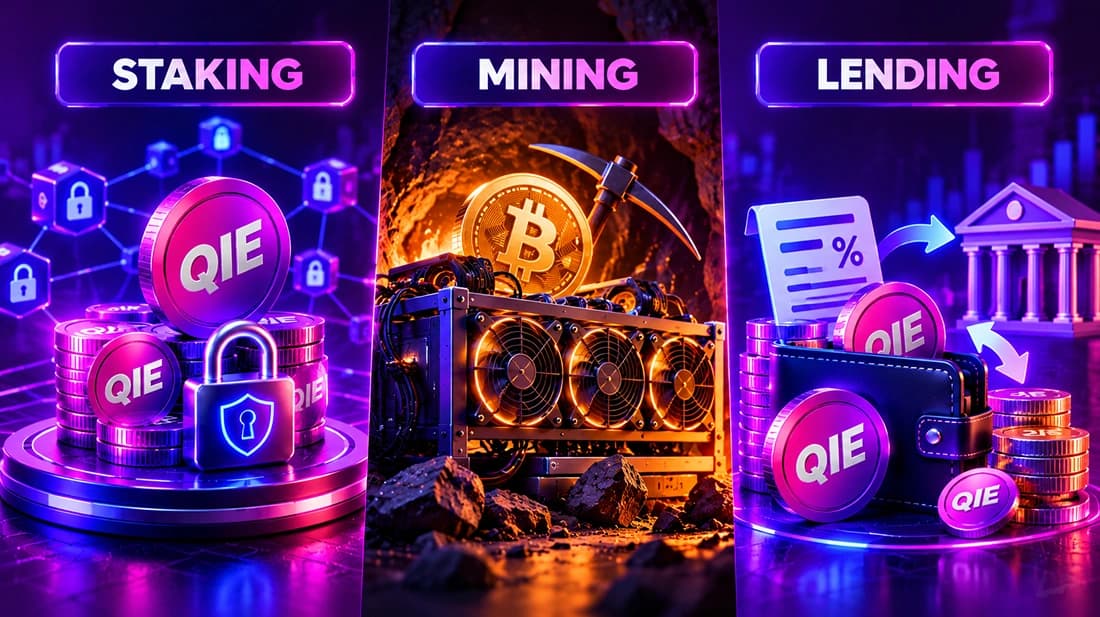
All three can earn you crypto, but they work very differently. This is crypto staking explained against its two main alternatives.
| Staking | Mining | Lending | |
|---|---|---|---|
| How it works | Lock coins on a proof-of-stake chain | Use computing power to secure a proof-of-work chain | Lend coins to a borrower or platform for interest |
| Hardware | None when you delegate | Specialized machines | None |
| Energy use | Low | High | Low |
| Main risks | Slashing, lock-up, price | Hardware cost, electricity, price | Borrower or platform default |
| Beginner-friendly | Yes | No | Depends on the platform |
How do you start staking in five steps?
If you are new, this order keeps things simple:
- Pick a coin you want to hold. Only coins on proof-of-stake networks can be staked.
- Choose how to stake. Wallet like QIE Wallet, exchange, delegation or liquid staking, using the table above.
- Check the terms. Read the rate, the fee, the minimum and the unstaking time on the platform’s own page.
- Start small. Stake a small amount first and confirm that rewards arrive as expected.
- Track and review. Watch your rewards and the lock-up date, and rebalance if your needs change.
Conclusion
Staking lets you earn rewards by helping secure a proof-of-stake network, and it suits patient beginners who understand the lock-up and the risks.
Choose the way to stake by custody, fees and how long you can wait to unstake, not by the highest rate.
Key takeaways
- •Staking locks your crypto to help secure a proof-of-stake blockchain, and you earn rewards for it.
- •Proof of stake relies on economic stake, not computing power.
- •APY includes compounding and APR does not, and rewards are never guaranteed.
- •The main risks are slashing, lock-ups and price swings, so stake only what you can leave untouched.
- •If you want to keep your own keys, a non-custodial wallet is a sensible place to start.
Ready to start? Stake QIE in QIE Wallet and keep control of your keys. Stakers also unlock perks such as up to 50% off QIE IDs and free partner subscriptions like Galaxi and Qbots.